When we discuss the Solar System, many questions arise, such as how it was created, when it was created, and so on. Our discussion provided some answers to these issues, which has piqued my interest!
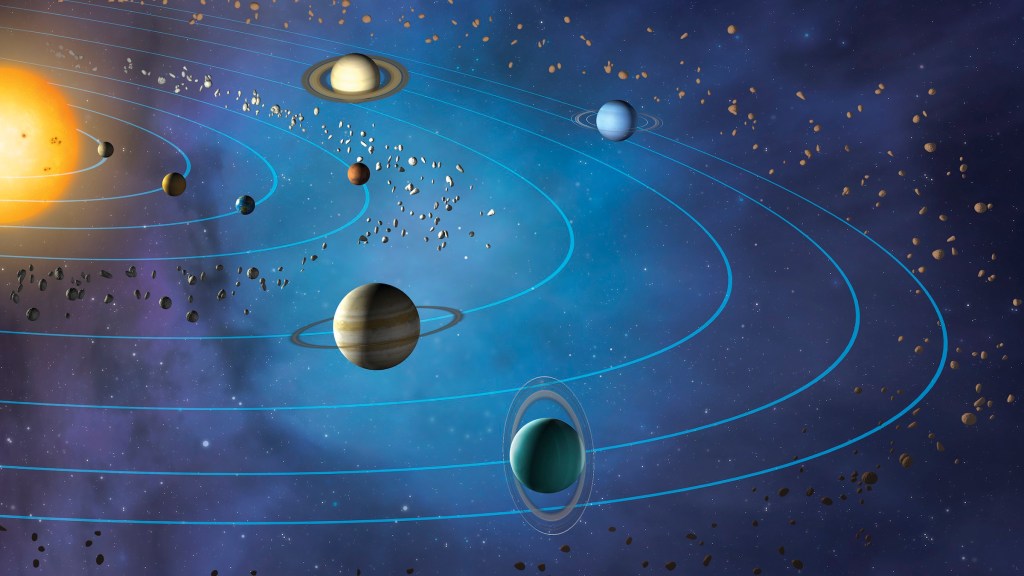
There are three theories concerning the Solar System’s formation in our discussion. The Protoplanet Theory, the Encounter Hypothesis, and the Nebular Hypothesis are the three theories.
NEBULAR HYPOTHESIS
The nebular theory proposes that a spinning cloud of material made largely of light elements, known as a nebula, flattened into a protoplanetary disk and evolved into a solar system with a star and orbiting planets. The sun accounts for approximately 99 percent of the mass in our solar system because the spinning nebula gathered the vast bulk of material in its center.
ENCOUNTER HYPOTHESIS
The encounter theory was one of the first explanations for the origin of the planets. A renegade star travels close to the Sun about 5 billion years ago in this scenario. The Sun and the rogue star are tidally stripped of material in the form of hot gas. Planets are formed as this material splits into smaller chunks. This idea has the advantage of explaining why all of the planets circle in the same direction (because to the encounter geometry) as well as why the inner worlds are denser than the outer worlds.
PROTOPLANET THEORY
A clump of stars is formed by a dense interstellar cloud. Because the little blobs have random spins, the emerging stars will have low rotation rates. Smaller blobs are captured by the star and become planets.
The small blobs would rotate faster than the planets of the Solar System, however this is explained by splitting the ‘planetary blobs’ into planets and satellites. However, it is unknown how the planets got to be restricted to a plane or why their revolutions are identical.
 Jeazelle